


In the days after the arrest of a Venezuelan man working as a food delivery driver in Bellevue last June, the Department of Homeland Security made a series of alarming allegations.
Gabriel Hurtado-Cariaco, 31, was referred to by DHS as a “criminal illegal alien” and a “known Tren de Aragua terrorist.” The agency said he “violently attacked an ICE agent” by slamming her head into the ground and attempting to choke her to death. At a preliminary hearing, a Homeland Security agent and a federal prosecutor said Hurtado-Cariaco received “special forces-type training” in the Venezuelan military and may have been involved in “killing people, hurting people, [and] committing human rights violations.”
Under scrutiny, much of the government narrative crumbled.
Hurtado-Cariaco sought asylum at the border in June 2023, and was paroled into the U.S. in 2024. He was granted work authorization and had an upcoming immigration court date. During a credible fear interview conducted in El Paso, Texas, he said he deserted the Venezuelan military because of disagreements with the Maduro regime and fled out of fear of retaliation.
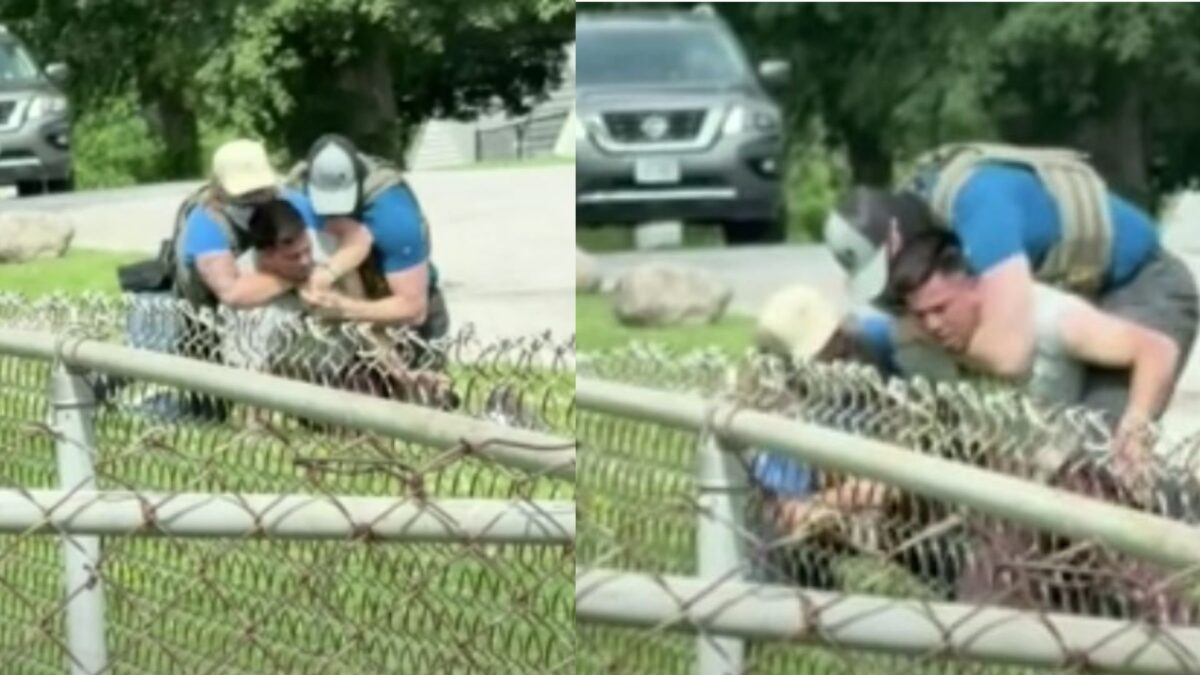
Two bystander videos of his arrest showed that he resisted being detained, at times pushing against the two agents who attempted to subdue him, but did not actively attack either of them. Prosecutors admitted that Hurtado-Cariaco had not choked the female officer as previously claimed, chalking it up to a “misperception” from the agent who wrote the affidavit that led to Hurtado-Cariaco’s arrest.
Initially arrested and later indicted on charges of attempted murder of a federal officer, Hurtado-Cariaco pleaded guilty on Thursday to one count of forcibly resisting arrest causing bodily injury as part of a plea agreement. He was sentenced to 14 months in prison – most of which he has already served, since he has been behind bars since his arrest.

U.S. District Court Chief Judge Robert Rossiter said at the sentencing that the allegations made in the initial complaint were “at worst a misrepresentation and at best complete negligence.” Though Rossiter said there is “no doubt” that Hurtado-Cariaco committed the offense that he pleaded guilty to by fleeing the officers and struggling with them, he found the law enforcement reports “embellished” and “troubling.”
“We have to be able to trust law enforcement,” Rossiter said. “In this case, in this very situation, I have some doubts.”
Federal Public Defender Richard McWilliams, Hurtado-Cariaco’s attorney, said in a sentencing memorandum that the Department of Justice and the Department of Homeland Security should be ordered to apologize for the falsehoods spread about his client. But at sentencing, McWilliams said it was clear that an apology was “not forthcoming.”
“I don’t think anyone is going to learn a lesson here,” McWilliams told Nebraska Public Media News.
The initial allegations
Thursday’s sentencing was the culmination of a yearlong prosecution.
Hurtado-Cariaco was on his way to register his car in Bellevue, where he lived with his girlfriend, when he was arrested on June 18, 2025. Immigration officials had obtained an administrative warrant for his arrest alleging that he was a member of Tren de Aragua, a Venezuelan prison gang that was designated a foreign terrorist organization last year.
The initial narrative of what happened during Hurtado-Cariaco’s arrest was provided by Immigration and Customs Enforcement agent Craig Allrich. Allrich, who was not at the scene of the arrest, penned the affidavit that would be used to secure a criminal complaint against Hurtado-Cariaco.
In federal court, a criminal complaint is typically a precursor to a grand jury indictment. It requires a law enforcement officer to submit a sworn statement, which is reviewed by a magistrate judge, who determines whether or not probable cause exists to believe the defendant committed the crimes.
The first complaint, which remains sealed, was filed the same day as Hurtado-Cariaco’s arrest. An amended complaint was filed one day later. According to a sentencing memorandum filed by McWilliams, the first complaint only alleged that he forcibly resisted arrest.
It was in the amended complaint that Allrich laid out how Hurtado-Cariaco allegedly attempted to murder the female ICE officer, referred to as “Victim 1” throughout the document. In Allrich’s telling, Hurtado-Cariaco exited his vehicle after the two agents pulled him over. Initially, Allrich said, he raised his hands and “made gestures and took a physical posture that signaled non-verbally to the agents that he would be compliant.”
But when the agents approached Hurtado-Cariaco to place him into custody, Allrich said, he began “twisting, fighting, and pushing” against the female agent, eventually throwing himself against her and causing her head to “smack harshly against the ground.”
Then, Allrich said, as the two agents struggled to detain Hurtado-Cariaco, he was “able to get control of Victim 1 and place [her] in a chokehold.” Allrich said the male agent gave repeated commands to Hurtado-Cariaco to release the chokehold, but he “chose to continue choking Victim 1 rather than simply fleeing the scene.”
In response, Allrich said, the male agent placed Hurtado-Cariaco in a chokehold, which caused Hurtado-Cariaco to release his grasp on Victim 1.
Videos of the interaction tell a different story.
Videos negate government narrative
Two bystanders, a father and son who lived near where the arrest took place, separately recorded parts of the incident. Both were called as witnesses during Thursday’s sentencing hearing.
The videos do not include footage of the traffic stop and initial interaction that led to the struggle in the grass. A factual basis agreed upon by the prosecution and defense said that Hurtado-Cariaco “forcibly resisted” the female agent’s efforts to detain him, and ran toward a house, at which point the videos began.
The first video was taken from inside a nearby car. The man who filmed it, Nathan Aragon, testified Thursday that he began filming about five seconds after the interaction began. Aragon said he did not see the female agent fall or sustain any injuries before he began recording.
Aragon’s video begins with the female agent placing Hurtado-Cariaco into a chokehold. As he continued to resist, she punched him in the arms with a closed fist.
Hurtado-Cariaco managed to stand up with both agents still clinging onto him. As they topple to the ground again, the male agent jumped onto Hurtado-Cariaco’s back and placed him into a headlock-style chokehold. As the first video ends, all three are on the ground as the agents struggle to subdue Hurtado-Cariaco and place his hands behind his back.
The second video was taken through the window of a home. It picks up shortly after the first video ends as they struggle on the ground. At one point, the male falls off of Hurtado-Cariaco’s back, but appears to keep a firm grip on one of Hurtado-Cariaco’s arms. The female agent is also on the ground, and Hurtado-Cariaco appears to push against her with his free arm, but the video does not show Hurtado-Cariaco choking her.
Hurtado-Cariaco managed to free himself from the agents as they grabbed at his shirt, which came off. The male agent briefly grabbed onto Hurtado-Cariaco’s leg as he ran away. As he ran away shirtless, the female agent followed him and attempted to grab onto his pants, which resulted in her falling to the ground as he continued to run. The video ends with Hurtado-Cariaco running down the street. He was arrested later in the day without incident.
At no point in either video is Hurtado-Cariaco seen choking the female agent. Instead, the videos show agents placing Hurtado-Cariaco into a chokehold on two separate occasions as he attempts to break free.
It isn’t clear when prosecutors became aware of the videos. McWilliams said the U.S. Attorney’s Office was aware of the existence of the videos early on in the case, and had the videos in their possession before seeking the indictment for attempted murder. The U.S. Attorney’s Office did not respond to requests for comment about the timeline in time for publication.
Venezuelans tied to gangs by tattoos, attire
Hurtado-Cariaco was first indicted on charges of attempted murder and resisting arrest last July. By November, prosecutors filed a superseding indictment, which abandoned the attempted murder charge and replaced it with another serious felony – providing material support to a terrorist organization.
The material support that Hurtado-Cariaco allegedly provided to the organization, Tren de Aragua, was identified as “himself, as personnel and by assaulting a federal officer.”
In available court documents, evidence of Hurtado-Cariaco’s gang membership is sparse. According to Allrich, he had already been identified as a Tren de Aragua associate before his arrest. A tattoo of a clock and eye on his forearm was further proof that he was associated with the gang, Allrich said.
“The prominent tattoo on Hurtado-Cariaco’s forearm, along with [Enforcement and Removal Operation’s] information on Hurtado-Cariaco’s associates in the Tren de Aragua gang and the fact that Hurtado-Cariaco desired to go to a Colorado prison were indicative to [Homeland Security Investigations] personnel on scene that he was likely also a Tren de Aragua gang member or close associate,” Allrich wrote in the complaint.
A photo of Hurtado-Cariaco’s tattoo included in McWilliams’ sentencing memorandum shows two figures walking together underneath an eye and a clock. The date April 30, 2018, is inscribed underneath.

That’s the birth date of Hurtado-Cariaco’s son, McWilliams said.
Hurtado-Cariaco is far from the only Venezuelan to be accused of Tren de Aragua membership because of his tattoos. Some of the hundreds of Venezuelan men who were deported and imprisoned in El Salvador’s megaprison CECOT were linked to Tren de Aragua because of tattoos of roses, stars, clocks or the Nike Jumpman logo.
Hurtado-Cariaco was threatened with imprisonment at CECOT during his detention, McWilliams said.
Many of the Venezuelans deported to El Salvador were identified as Tren de Aragua associates or members through the ‘Alien Enemy Identification Guide’ checklist, which assigns points to activities allegedly associated with the gang – like “tattoos denoting membership” or the use of gang-affiliated “hand signs.” The same checklist may have been used to link Hurtado-Cariaco to Tren de Aragua.
McWilliams said the methods used to identify alleged members of Tren de Aragua “makes McCarthyism look intellectual and rational.” In his own statement, Hurtado-Cariaco lamented that he had been accused of involvement in a “terrorist organization that I myself detest and abhor.”
‘Not borne out by the evidence’
Rossiter said Thursday’s detention hearing was “out of the ordinary.” Assistant U.S. Attorney Don Kleine did not cross-examine either witness called by the defense, and he largely referred the judge to the government’s sealed sentencing memorandum instead of offering argument.
“This was a heat-of-the-moment situation, and there was a misperception of what occurred,” Kleine said.
McWilliams, however, said the allegations against Hurtado-Cariaco went far beyond a misperception.
“I’ve used the word falsehood or inaccuracy,” he said. “I don’t see any other way to frame what happened, which is that they lied about him. Sometime between the arrest and the drafting of the amended complaint, there was a decision made by somebody to fabricate a detailed story.”
Though Rossiter said he would not go so far as to say that the agent who wrote the initial affidavit was lying, he did say the facts were misrepresented – by “negligence,” “sloppiness” or “embellishment.” He took issue with the fact that Allrich, who wrote the affidavit, was not at the scene of Hurtado-Cariaco’s arrest.
“To refer to him as a terrorist, attempted murderer, that he had put a chokehold on these victims… It’s just not borne out by the evidence,” Rossiter said. “And it’s troubling.”
In a lengthy statement to the court before his sentence was pronounced, Hurtado-Cariaco told Rossiter that his previous traumatic experiences with police in other countries caused him to panic and flee. He suffered torture at the hands of police in Venezuela, he said, and was robbed by cartel members dressed up as police in Mexico.
“Over 12 months ago, when U.S. police officers arrested me with their faces covered, I was very afraid,” he said. “I still carry with me the trauma and I have not been able to overcome it. And for that reason, I ran away in fear. Those very painful memories of fear from my past had been triggered. And I believed that I would suffer it all again.”
The news of Hurtado-Cariaco’s arrest – and the allegation that he was a member of Tren de Aragua – reached his family and community in Venezuela. The case received massive media attention across the U.S. and in Venezuela.
Neither McWilliams nor Hurtado-Cariaco himself know how his immigration case will progress after he is released from federal custody. But Hurtado-Cariaco holds out hope.
“Despite all of the things that were published against me, I will continue believing in God, and in this country,” he said.