


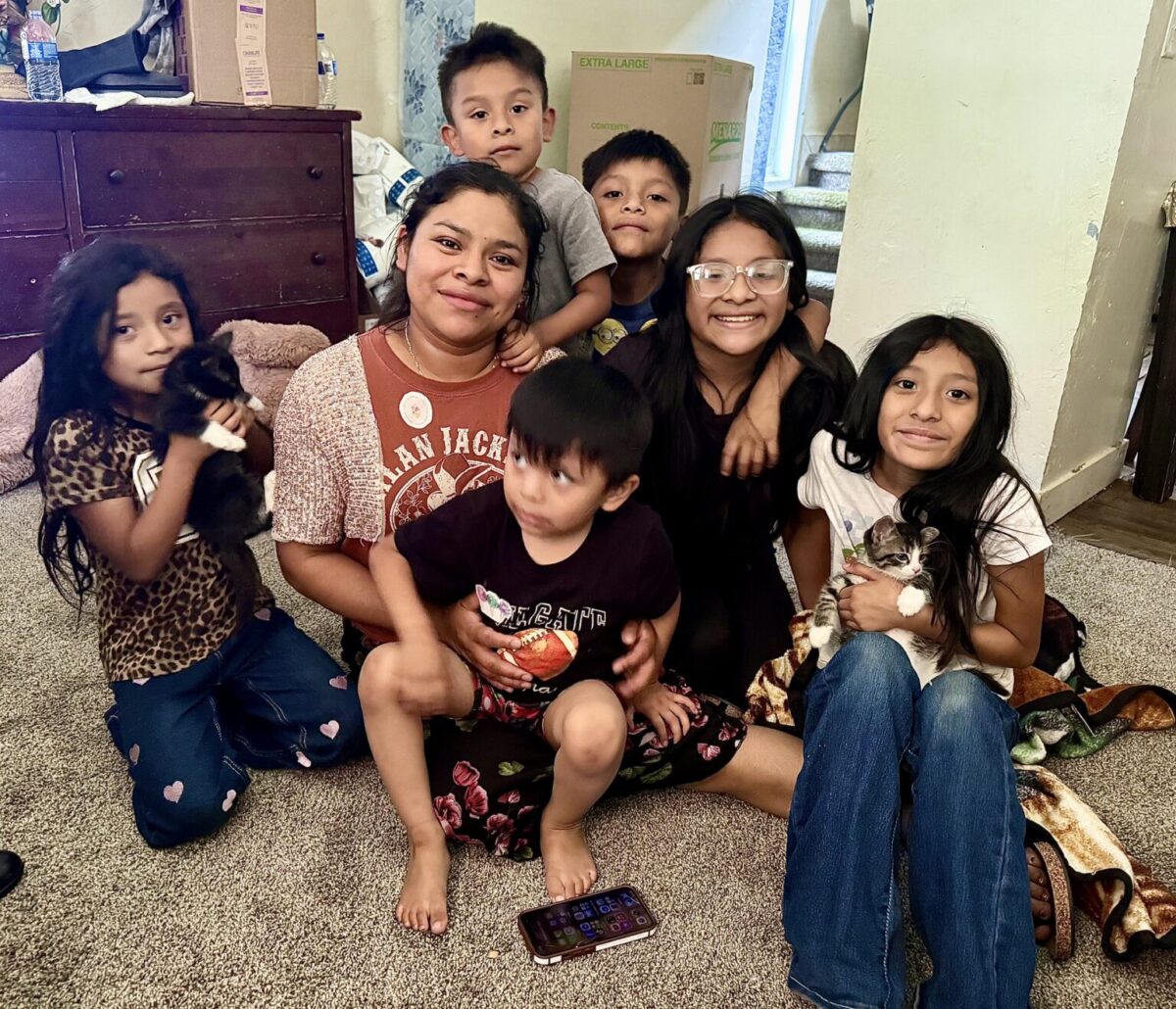
The Guatemalan mom left the Omaha immigration office, a monitor attached to her ankle, and immediately called her teenage son who was at home watching seven younger siblings.
She was coming home, Isabel Quinilla Pu told her kids.
For now at least.
“They’re happy,” the undocumented 35-year-old said of her children’s reaction following the June 11 check-in appointment. She went on to text a friend, her smile belying the mounting stress of the past year and a half.

Anxiety had escalated in her household after an immigration judge in May denied Isabel’s request to reconsider a prior order that she be removed from the country. The ruling made her vulnerable at any moment to detention and deportation, and she had feared the worst might happen that morning.
Though she returned home to hug her kids, advocates describe it as a reprieve to allow Isabel time to line up necessary documents for her little ones to travel, return with her and function in her birthplace. All the kids — age 4 to 17— are U.S.-born citizens.
An attorney at the Omaha-based Center for Immigrant and Refugee Advancement, which is helping the family, believes the federal government doesn’t want to be “on the hook” for children without a parental anchor. The kids’ dad previously was picked up by U.S. Immigration and Customs Enforcement. He is in a Texas jail, facing time for unlawful re-entry to the country, and unlikely to return to them any time soon.
Meanwhile the family’s South Omaha home reflects a unit preparing for upheaval. Boxes of clothes and household items sit ready to grab. Legal paperwork delegating responsibility for minors is secured.
For now, the mom anticipates leaving her four oldest kids at least temporarily with a trusted guardian in Omaha and taking the four younger ones with her. At times she second guesses herself. Will the children be OK without their parents? When will she see them again?
The family’s emotional ups and downs offer a peek inside a local household separated as President Donald Trump’s administration acts on his campaign pledge to execute America’s largest deportation of undocumented immigrants.
Claiming a “seismic turnaround” in stopping illegal border crossings, national security threats and unchecked migration, Trump has said his efforts have led to lower housing costs, better wages and less crime.
In this case, hanging in the balance are eight Nebraska-reared kids who have never set foot in the largely impoverished country their parents fled two decades ago when both were still teens.
More Nebraska youths at risk
According to a recent analysis by the nonpartisan Brookings Institution, about 145,000 U.S. citizen children of immigrants likely have been impacted so far by a parent’s detention under the latest Trump administration. That estimate includes about 22,000 kids nationally who were left without both co-resident parents.
The number facing the threat of family separation is much higher, said researchers at the Washington D.C.-based public policy think tank. Brookings partnered with the Center for Migration Studies in New York on a separate study last year and reported that 3.8% of all U.S. citizen children in the country were at risk of being left with no parent in their home under a mass deportation scenario.

Looking at Nebraska, that earlier research estimated that 16,100 U.S. citizen children live with two undocumented parents, meaning up to 3.5% of the Cornhusker state’s youths potentially could be left without any parents in the home due to deportation.
The federal government, via a “Detained Parents Directive” issued by ICE to agents last summer, seeks to ensure that immigration enforcement does not “unnecessarily infringe upon the legal parental or guardianship rights” of noncitizens caring for minor children.
The directive says that absent signs of neglect or abuse, federal agents should accommodate a parent’s efforts to make alternative care arrangements for children prior to detention.
Economist Tara Watson, a lead researcher at Brookings, said the lack of consistent and comprehensive government data obscures the true scale of youths affected by immigration enforcement, and undermines the ability to assess and deliver needs.
She told the Examiner that no governmental entity is responsible on the front end for ensuring that the children don’t “slip through the cracks.”
As is the case with Isabel’s household, parents typically prepare emergency plans dictating where kids should go if they are detained or deported, Watson and others said.
Though ICE legally can’t deport American children, Watson said anecdotal information indicates some kids accompany parents on government-sponsored deportation flights.

She said that in a fraction of cases — perhaps 5% of the estimated 22,000 American kids left without both detained parents, according to the Brookings research — state public welfare systems get involved.
If a citizen child of deported parents later is found to be in a dangerous placement or situation, a government arm could intercede as is the case in non-immigration related scenarios.
In Nebraska, a network of nonprofits including the Heartland Workers Center and the Center for Immigrants and Refugee Advancement have been called upon even more since the second Trump administration to help families with free legal and other support.
Representatives of those agencies urged Isabel to devise a preparedness plan so custody of her children is not left to chance.
One nonprofit has offered to pay plane fare for the younger children to return to Guatemala with their mom.
The arrangements gave Isabel both relief and heartache, she said. Pressure has been building since early 2025 when ICE agents arrested her husband on his way to work at a Millard area packing plant.
‘Dad got detained’
It was before 6 a.m. on a school day, and the oldest child Alex was awakened by the phone ringing. His father Andres was on the line and asked the son to wake up his mom.
“I burst into my mom’s room, ‘Dad got detained by ICE.’ I think I woke up my siblings,” the now 17-year-old recalled. “My mom was like, ‘What? What?”
The dad’s detention led to a series of events, including his removal from the country and a failed attempt to return to his family in Nebraska, which exacerbated his legal problems.

Isabel said she tried to work more to pay lawyer fees. At the time she was employed at Omaha’s Glenn Valley Foods. As part of the second shift maintenance crew, she was not at the plant the morning of June 10, 2025, when a large-scale worksite raid detained about 75 workers. But she never went back after that, leaving the family without its remaining full-time income source.
“That’s when I realized I was completely alone,” she said. “I felt hate … and then I remembered I need to put God in my heart for my family, to keep us going.”
Alex skipped a summer school class he planned to attend and found landscaping work. “I had to help my mom pay the bills,” he said, and later switched to a job at a fast-food restaurant.
The teen said his mom fills him in on some concerns, but mostly tells him “not to worry.” He said he tries to find ways to lift his siblings’ spirits.
Isabel recalled a time she gave her oldest son money for snacks but he brought home a cat instead. Mom let the pet stay, saying “Princesa” was a welcome distraction for the younger kids.
A lot of feelings came back … Do I have to leave my education again?
– Oldest son of Isabel Quinilla Pu
Alex said he didn’t expect the next blow that came shortly after the new year. ICE agents knocked on the family’s door, this time looking for Isabel and citing a past removal order. Seeing little ones in the house, the agents handed her a notice to report in February to Omaha’s immigration courthouse.
Said son Alex: “A lot of feelings came back … Do I have to leave my education again?”
It was at that February appearance she was ordered to wear an ankle monitor and report for scheduled appointments. Douglas County Court records show one infraction, where she accepted a plea last year for not having a driver’s license, and paid a $124 fine.
CIRA’s legal team tried to get Isabel’s prior removal order case reopened but was denied May 5. While unsuccessful on that front, Araya said, “We were able to buy more time” so she could determine her kids’ fate.
Children torn about leaving
Isabel’s eyes lit up when her husband called from the Texas jail. The couple, speaking their native Quiché language, is able to communicate by phone to discuss next moves.
When they reunite after his jail time, Isabel said they’ll likely go to Mexico where, she said, they foresee more work opportunities that would support their family split between countries.

The couple met at a funeral in their hometown in rural Guatemala when she was about 13 years old and he was 16. Isabel said her mom believed she was too young to date, though they kept in close touch.
Andres came to the U.S. in 2006, and a year later Isabel crossed with her father and settled in a different state. She said her dad gave the OK for Andres to move where they were in Kansas, and the couple married in 2008 at ages 17 and 20.
After their first child was born, the couple moved to Omaha.
“Someone said it was a beautiful place with a lot of work,” said Isabel.
Today, her kids are torn about leaving.
With one year left in high school, Alex is adamant about staying. He likes his wrestling team and wants to study business in college. What he knows of his parents’ rural hometown is not too alluring.
“My parents told me the reason they came here was to give us a good future and not suffer like they did,” the teen said. “They had no roads and had to walk, like miles, to go to the plazas or anywhere.”
Ana, who soon will turn 13, said she’s looking forward to entering eighth grade in the fall and possibly becoming an actress. All the kids are bilingual in English and Spanish. Some understand their parents’ indigenous language.
“It breaks my heart” to think the family may be divided, said Ana. “Right now all I can do is be a good student and help keep the house steady.”
Juana, who is set to start middle school, has mixed feelings. The 11-year-old is the youngest of the four siblings likely to remain in Omaha with a guardian.

She’d like to see her grandmother in Guatemala, whom she has only spoken with by phone. She wants to be with her mom, yet she doesn’t want to move away.
Already, Juana said, memories of her dad are fading. “Sometimes I feel like I never had a dad,” she said. “And then I remember him, and I feel sad.”
Moises, 9, is among the four youngest likely going with their mom. He imagines Guatemala with a pool and soccer fields. He likes his Omaha school and said he gets mostly As and a few Bs. In one breath he says he’ll be fine, in the next he says: “I’m not going to learn over there.”
Selena, 7, is busy with her youngest brothers corralling six kittens that Princess recently gave birth to. The littlest siblings prefer playing than mulling their future.
‘If God wants, ‘I’ll leave’
Before and after the June 11 check in, Isabel talked to friends and supporters about possible options that might remain for her to stay longer with all of her kids in Nebraska.
Finances remain stretched. Nonprofits have assisted with rent and utilities, but the agencies have limits and other clients. Supporters and friends have offered babysitting and housecleaning work here and there. The children are eligible for public food assistance, but Isabel said she was checking on the past month’s delay.
She grasped a Saint Benedict medal a friend gave her as a symbol of protection.
“I try not to be sad,” she said. “If God wants me to leave, I’ll leave.”